—-
To stay in the loop with the latest features, news and interviews from the creative community around licensing, sign up to our weekly newsletter here


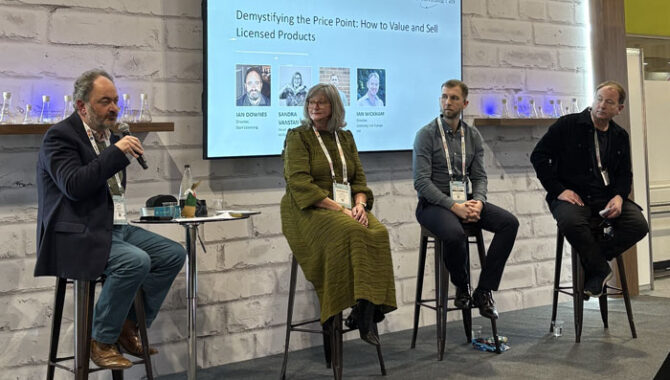
Fresh from a Spring Fair panel session hosted by Start Licensing’s Ian Downes at Spring Fair, Licensing Link’s Ian Wickham, William Lamb’s Sandra Vanstan and OddBalls’ Matthew Gibson discuss what licensing offers retailers.
Earlier this month, Spring Fair hosted a dedicated licensing area called the Licensing Lab.
It blended space populated by exhibitors like Emma Lawrence, OddBalls and art licensing agency Jehane with a theatre space that played host to a well-curated programme of panels and interviews. The emphasis on these sessions was providing further insights into the world of licensing and participants included Aardman Animations, the V&A Museum and Liberty.
Part of the rationale for including an educational element in the Licensing Lab was to build on the growing role licensing is playing in the gift industry – and the show floor featured a host of companies that include licensed products in their product portfolios.
Ian Downes from Start Licensing hosted a panel discussion featuring Ian Wickham from Licensing Link, Sandra Vanstan from William Lamb and Matthew Gibson from Oddballs. The topic for the panel discussion was: ‘Demystifying the Price Point: How to Value and Sell Licensed Products.’
The panel touched on a number of areas connected to this topic, including product development and how retailers can benefit from licensed products. The panel also highlighted that rights owners are more willing than ever to engage with retailers – big and small – to create promotional activity focused on driving up customer engagement.
Below is a recap from the panel on some of the key points raised in the discussion:
Should retailers be concerned about the price of licensed products?
Matthew Gibson, Head of Partnerships & Licensing, OddBalls: No! It’s something to be considered but not feared. It’s not a secret that licensed products can be more expensive as they include MGs, royalties and often marketing spend commitment. The key is to forecast accurately and understand the overall financial undertaking if taking a license themselves. Or, when looking to buy in a licensed range, make sure their customers are willing to pay the price point.
Sandra Vanstan, Head of Licensing, William Lamb: Retailers should naturally be concerned about price points to remain competitive. However, buyers are under enormous internal pressure to focus on margins, and often, sadly, it’s the product that suffers.
Ian Wickham, Co-Founder, Licensing Link: Licensed products come with the perception of being slightly more expensive than generic products for a number of reasons… The value associated with the license, the quality associated with the license, consumers wanting to own a ‘piece’ of a license and the additional costs that have gone in to creating the products – like rigorous QA testing to hit the licensor’s brand requirements.
“There’s a credibility and gravitas associated with some licenses.”
Plus, there’s an expectation that the licensed product – because of all the above – will last longer than a generic one. All of this comes with a cost associated with it. So retailers should not be concerned with marking their licensed products up with a premium within their overall offer to consumers.
For retailers, what are the benefits of licensed products?
Sandra Vanstan, William Lamb: If you have ever experienced a child’s tantrum over a Frozen doll, then you will understand the benefits of selling licensed products!
Matthew Gibson, OddBalls: The reputation of the brand itself is a huge pull to purchase for the customer. It will allow a retailer to trial a new category or product, before bringing in a wider range in that category. All because the licensed brand will have an existing following and strong fanbase to purchase new product. Licensing a new design of an existing range will add great value for minimal cost.
Ian Wickham, Licensing Link: By supporting licensed products, retailers have the ability to increase their basket spend – as well as build on a loyal shopper that wants to come back and purchase further into a range of licenses. Additionally, there’s the benefit of offering consumers a point of difference as well as choice – this all enhances their shopper experience.
On top of this, there’s the credibility and gravitas that can be associated with some licenses which can lead to additional sales and up-selling, as well as building the retailers credibility about their offering too.
“For bricks-and-mortar stores, it’s about selling around an event or experience…”
The sale of licensed products could also encourage retailers to expand their offer into additional categories that have synergy with their current lines and what the license can deliver. This further enhances their credibility as well as repeat footfall with consumers coming back to buy into the extended ranges.
How can retailers highlight the added value licensed products deliver in their stores?
Ian Wickham, Licensing Link: Great use of POS in store to communicate the arrival of licensed product is a great way of explaining and educating the consumer all about the products and range. Most licensors have pre-approved toolkits for retailers to use in store, so the effort to deliver this is fairly minimal from the retailer’s perspective – an easy win.
I’d also suggest using social platforms too. Do mail outs explaining the value associated with licensed products in-store or online, and social media posts communicating the features, benefits and the additional points of difference to entice a consumer. Website takeovers are also a very easy win for retailers to communicate the value associated with the products.
If relevant, character visits to the store can generate additional theatre, atmosphere and occasion. It’s great for families, magical for children and a great way of delivering added value around a particular license.
Finally, cross category promotions and merchandising various items together can make a statement in store. Have licensees work together to make the offer cover a multitude of purchase occasions.
Matthew Gibson, OddBalls: I’d suggest small POS assets like ‘Official Merchandise’ and using social media constantly to show people what is in store. Retailers who tap into super fans through clever marketing will also see significant value when retailing licensed products.
Sandra Vanstan, William Lamb: For retailers trading in ecommerce, high-quality photography and video are essential, with aspirational lifestyle shots helping to showcase products at their very best. For bricks-and-mortar stores, it’s about selling around an event or experience… Whether that’s supporting a key anniversary or capitalising on a much-anticipated movie release with merchandise that customers can quite literally dress themselves in from head to toe.
Finally, which licensed product of yours would you highlight as a good example of licensing?
Matthew Gibson, OddBalls: I’d highlight our most recent licensed range with Aardman’s Wallace & Gromit. Launched in a timely manner at the start of Aardman’s 50th anniversary, the range captures the personality and charisma of the iconic duo. The design is on brand and relatable for fans. Seeing Wallace in his dressing gown enjoying a brew, Gromit sewing and his cute but often puzzle facial expressions make for a superb first design for the collection!
The range launched at a topical time, used great design assets and was marketed strategically to the fanatical fan using Wallace & Gromit branded slogans, other characters and a wide range of well know icons from the show.
“Retailers who tap into super fans through clever marketing will see significant value.”
It’s a wonderful example of the amalgamation of two brands creating one superb range of desirable products! Not to mention the high percentage of returning customers who bought, showing the brand fit was incredibly accurate but, also a 99.93% sell through in just three weeks…
Ian Wickham, Licensing Link: I’d go for the Floral Street Sunflower Pop and Sweet Almond Blossom parfum. Created using 100% vegan ingredients, the formulation for both was created using inspiration from where Vincent van Gogh painted in Arles, France.
Floral Street themselves are a disruptor in the fragrance category, just as Vincent was in the art world. The business was set up by one very driven lady – just as Vincent was self taught, getting knock backs as he improved his designs and signature brushstrokes. Floral Street are trailblazing in the category they operate in, as Vincent was too – so it’s a great match.
The use of storytelling is key to the overall execution which fits in with the Van Gogh Museum’s strategy to get the message out about Vincent and his art. ‘If one loves nature, one finds beauty everywhere’ is what Vincent wrote to his brother Theo. This is the overall message and carrier for the Floral Street x Van Gogh Museum range which is pertinent to the use of natural ingredients as well as Floral Street’s use of flowers. As is the overall strapline of ‘Where fine art meets fine fragrance’, cementing together the relationship between licensor and licensee.
Sandra Vanstan, William Lamb: One of my proudest product launches was an Enormous Crocodile slipper set we developed for Start-Rite, which included Roald Dahl’s The Enormous Crocodile book alongside a beautifully crafted, premium pair of slippers. The crocodile’s appliqued mouth stretched across the vamp of both feet, forming the full character when placed together. Seeing the product in store was an absolute squeal moment.
Brands Untapped’s Billy Langsworthy heads to Milan to check out Rainbow’s Home Fairy Home exhibition – and see first-hand the value of student collaborations.

From Crayola Doodle Coasters to a Teenage Mutant Ninja Turtles Sewer Launch… Industry figures share their picks for IP well-suited to rollercoasters.
We asked figures in the industry for their favourite licensed launches of the year. The only caveat… They couldn’t choose a product they were involved in!
Dot Dash Design’s Paula Rich, independent creative Danny Heffer, Apparel of Laugh’s Jude Coram and Doodlebug Design’s Maria Thomas give us their half-year review.

We asked industry figures what they’d like to see more of from the licensing sector – and what they want less of…
Following World Book Day, we’re asking: What books remain untapped in terms of their licensing potential? And why would they thrive in consumer products?

Receive the Brands Untapped Newsletter
Enter your details to receive Brands Untapped updates & news.